




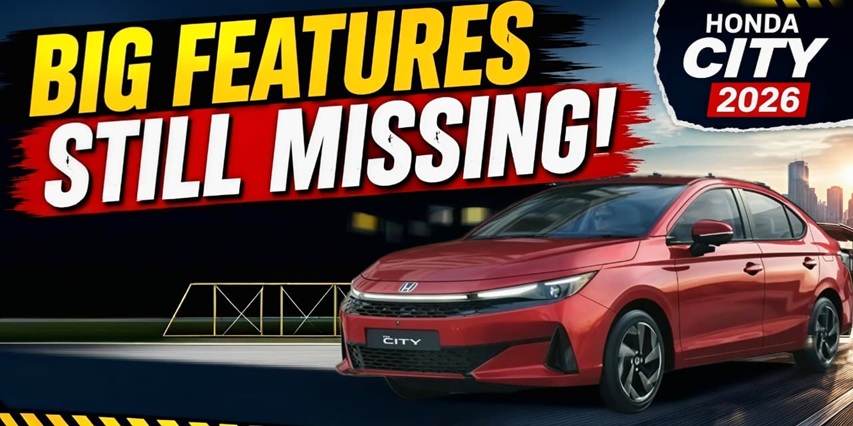
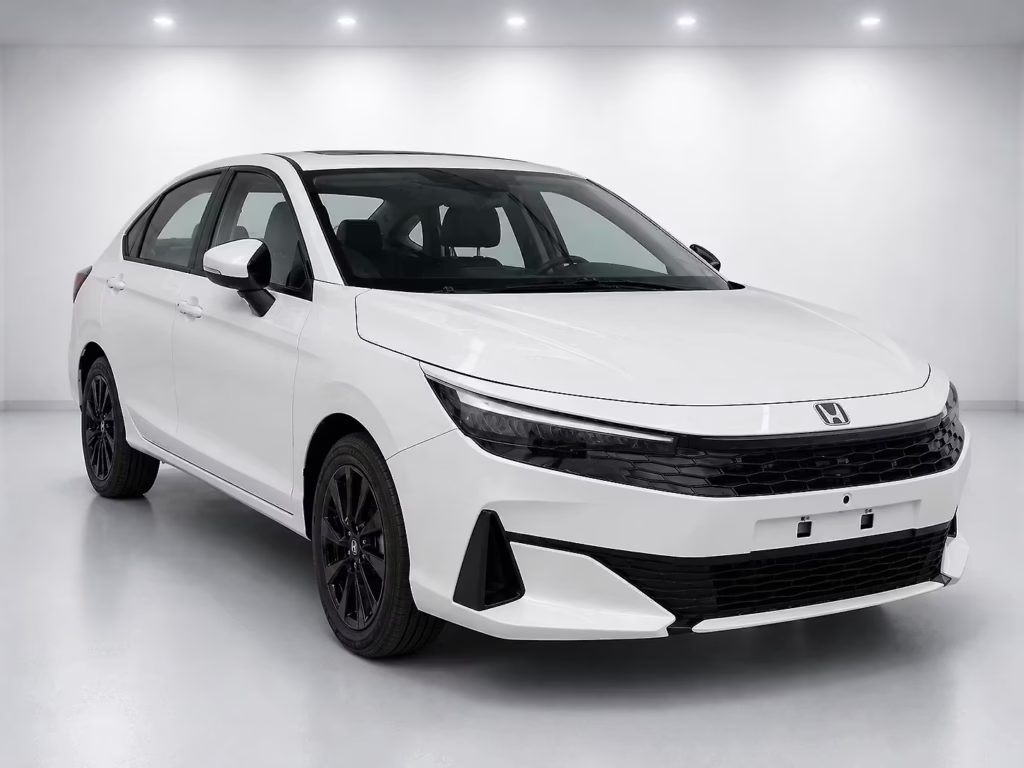
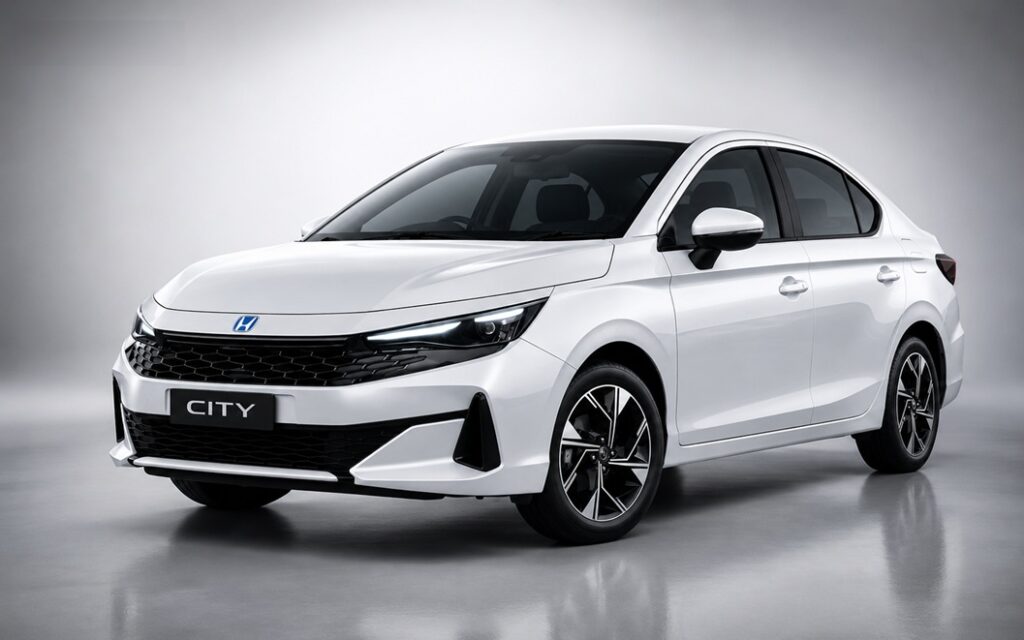
The 2026 Honda City facelift has finally arrived in India, and it brings a sharper look, a bigger screen, and some welcome comfort upgrades. But if you are a true automobile enthusiast hungry for automobile content for car enthusiasts, you might feel a little let down. Because despite the refresh, the new City still misses out on several features that its segment rivals have been offering for a while now.
- 1. What Is New in the 2026 Honda City Facelift?
- 2. No Turbo Petrol Engine – A Major Gap for Performance Lovers
- 3. No Powered Front Seats
- 4. Single-Zone Climate Control Only
- 5. No Panoramic Sunroof – Only a Standard Unit
- 6. No Blind Spot Monitor (BSM)
- 7. No Rear-Seat Entertainment or USB-C Charging
- 8. No Fully Digital Instrument Cluster
- 9. Feature Comparison: 2026 Honda City vs Rivals
- Conclusion
We dug deep into the specs, competitor comparisons, and owner expectations to bring you the most relevant automobile and car related information on exactly what is still absent from the 2026 Honda City.
1. What Is New in the 2026 Honda City Facelift?
Before we get into the misses, let us quickly acknowledge what Honda did add. The 2026 City facelift is not a bad update by any means. It brings genuine improvements to the table.
- A redesigned front with LED DRLs connected via a light bar
- A new 10.1-inch floating touchscreen with wireless Android Auto and Apple CarPlay
- Ventilated front seats – a first for the City
- 360-degree camera system
- Expanded ambient lighting across the cabin
- 8-speaker premium sound system
- New 16-inch aero-blade alloy wheels
- 5-year warranty on hybrid components (e:HEV)
Prices start at Rs 12 lakh (ex-showroom) for the base SV petrol manual and go up to Rs 21 lakh for the top ZX+ strong hybrid variant. The e:HEV strong hybrid claims an impressive 27.26 kmpl.
So yes, the facelift is a step forward. But here is the thing — for automobile enthusiasts comparing it with the Hyundai Verna, Skoda Slavia, and Volkswagen Virtus, it still has clear shortcomings.
2. No Turbo Petrol Engine – A Major Gap for Performance Lovers
This is the biggest elephant in the room. The 2026 Honda City still relies on the same 1.5-litre naturally aspirated petrol engine producing 121 PS and 145 Nm of torque, mated to a 6-speed manual or 7-step CVT.
Rivals like the Hyundai Verna offer a 160 PS turbo-petrol engine with a 7-speed DCT gearbox. The Volkswagen Virtus and Skoda Slavia both offer a 1.5-litre TSI turbo with 150 PS, paired to a quick-shifting DSG automatic.
If you want spirited highway driving or strong mid-range punch, the City’s NA engine simply cannot match its turbocharged competition. For automobile enthusiasts who prioritise performance in their automobile and car related information searches, this omission is hard to overlook.
- City: 121 PS naturally aspirated | 0-100 km/h in ~11 seconds
- Verna Turbo: 160 PS | 0-100 km/h in under 9 seconds
- Virtus/Slavia TSI: 150 PS | 0-100 km/h in about 8.5 seconds
Honda does offer the e:HEV hybrid which is smooth and fuel-efficient, but it is a different proposition altogether — priced at Rs 21 lakh, it competes with compact SUVs rather than mid-size sedans.
3. No Powered Front Seats
Power-adjustable front seats are quickly becoming a segment standard. The Hyundai Verna offers both powered driver and front passenger seats at its top trims. The 2026 Honda City still misses this feature across its entire lineup.
The standard City facelift does not get powered front seats, and even the hybrid ZX+ variant is unlikely to offer it. For buyers in the Rs 17–21 lakh bracket, this is a noticeable omission.
Manual seat adjustment in a car priced at over Rs 17 lakh feels out of place in 2026. This is a feature worth calling out in any honest automobile content for car enthusiasts.
4. Single-Zone Climate Control Only
The 2026 Honda City continues with a single-zone automatic climate control system. There is no dual-zone climate control on offer — not even on the top ZX+ hybrid trim.
The Hyundai Verna, by contrast, offers dual-zone climate control at its higher trims. For couples or families who spend long hours on the road, this matters. One person may want it cooler while another prefers warmer air — with the City, there is no such flexibility.
It is a small thing that adds a big comfort difference on long drives. Worth noting for all automobile and car related information seekers evaluating the City seriously.
5. No Panoramic Sunroof – Only a Standard Unit
The Honda City does get a sunroof — but it is a standard slide-and-tilt electric sunroof. A panoramic sunroof, which gives a much larger open-sky feel for both front and rear passengers, is simply not on the menu.
Given that panoramic sunroofs are now common even in sub-20-lakh cars like the Tata Nexon and Hyundai Creta in the SUV space, buyers do expect more from a sedan pushing Rs 17–21 lakh at the top trim.
The existing sunroof is functional and includes remote open/close at the ZX+ trim, but it is not the sweeping panoramic unit competitors are beginning to offer. A point of disappointment for lifestyle-focused automobile enthusiasts.
6. No Blind Spot Monitor (BSM)
Honda does include a LaneWatch camera — a camera mounted on the left ORVM that shows a live feed of the left blind spot. It is a unique Honda system and genuinely useful. However, it only covers the left side.
There is no radar-based Blind Spot Monitor (BSM) that alerts you to vehicles in both the left and right rear blind zones simultaneously — the kind of system found in the Hyundai Verna.
On Indian expressways and multi-lane roads, a full BSM system adds meaningful safety. The LaneWatch is clever but half a solution. This is a gap in the City’s safety and technology package that serious automobile content for car enthusiasts will flag.
7. No Rear-Seat Entertainment or USB-C Charging
Rear-seat entertainment is admittedly rare in this segment. But rear USB-C fast-charging ports are not — and the City’s rear passengers are not well served on this front either.
At Rs 17–21 lakh, buyers expect their rear-seat passengers to be able to charge devices conveniently. While the cabin is comfortable with good knee room and rear AC vents, the technology experience for rear passengers lags behind what rivals are beginning to offer.
This is something that is easy for Honda to fix in a minor update, but for now, it remains a missed opportunity.
8. No Fully Digital Instrument Cluster
The 2026 Honda City retains a part-digital instrument cluster — the same 7-inch digital MID unit seen in the previous model. The surrounding analogue gauges remain.
The Hyundai Verna features a fully digital 10.25-inch driver display as part of its dual-screen setup. The Volkswagen Virtus and Skoda Slavia also offer a digital cockpit option at higher trims.
A fully digital driver’s display is not just aesthetic — it allows more information, better customisation, and a more modern feel. The City’s part-digital setup is functional but increasingly dated in the 2026 context.
9. Feature Comparison: 2026 Honda City vs Rivals
| Feature | Honda City 2026 | Hyundai Verna | Skoda Slavia | VW Virtus |
| Turbo Petrol Engine | No (NA only) | Yes (160 PS) | Yes (150 PS) | Yes (150 PS) |
| Powered Front Seats | No | Yes | No | No |
| Dual-Zone Climate | No | Yes | No | No |
| Panoramic Sunroof | No | No | No | No |
| Blind Spot Monitor | No (LaneWatch only) | Yes | No | No |
| Full Digital Cluster | No (Part-digital) | Yes (10.25″) | Yes | Yes |
| 360° Camera | Yes | Yes | No | No |
| Ventilated Seats | Yes (ZX+) | Yes | Yes | No |
| Strong Hybrid | Yes (27.26 kmpl) | No | No | No |
| ADAS (Level 2) | Yes | Yes | No | No |
| Starting Price (ex-sh.) | Rs 12 lakh | Rs 10.98 lakh | Rs 10 lakh | Rs 10.5 lakh |
Conclusion
The 2026 Honda City facelift is a meaningful update — sharper design, ventilated seats, 360-degree camera, and a bigger touchscreen make it a better product than its predecessor. The e:HEV strong hybrid remains a segment-exclusive highlight with an outstanding 27.26 kmpl efficiency claim.
However, for automobile enthusiasts seeking complete automobile and car related information before making a decision, the gaps are real. No turbo petrol engine, no powered front seats, no dual-zone climate control, no BSM, and a part-digital cluster hold the City back from being the segment’s all-around leader.
If fuel efficiency and reliability are your priorities — especially with the hybrid — the Honda City is a smart choice. But if you want maximum features per rupee, the Hyundai Verna edges ahead on sheer equipment value.
The City’s saving grace? Honda’s reliability reputation, the unmatched hybrid powertrain, and Level 2 ADAS at this price point. The decision ultimately depends on what you value most.
Have you test-driven the 2026 Honda City? Drop your experience in the comments below.
Also Read ;- Honda City vs Hyundai Verna 2026: Full Comparison You Must Read
FAQ Section
Q1: Does the 2026 Honda City have a turbo petrol engine?
No. The 2026 Honda City facelift continues with the same 1.5-litre naturally aspirated petrol engine producing 121 PS. There is no turbo petrol option. Rivals like the Hyundai Verna, VW Virtus, and Skoda Slavia all offer turbocharged engines in this segment.
Q2: Does the 2026 Honda City have ventilated seats?
Yes, ventilated front seats are a new addition to the 2026 Honda City. However, they are available only on the top ZX+ variant. Lower trims like SV and V do not get this feature.
Q3: What is the mileage of the 2026 Honda City hybrid?
The 2026 Honda City e:HEV strong hybrid claims a fuel efficiency of 27.26 kmpl. It uses a 1.5-litre hybrid powertrain with 126 PS and 253 Nm of combined torque, making it the most fuel-efficient option in the mid-size sedan segment.
Q4: Does the 2026 Honda City have a blind spot monitor?
The 2026 Honda City does not have a radar-based Blind Spot Monitor (BSM). It does include Honda’s LaneWatch camera on the left ORVM, which displays a live feed of the left blind spot on the infotainment screen. Right-side blind spot coverage is absent.
Q5: Is the 2026 Honda City worth buying over the Hyundai Verna?
It depends on your priorities. If you want the best fuel efficiency and reliability with a strong hybrid option, the Honda City wins. If you want more features per rupee — including turbo engine, powered seats, dual-zone climate, and a full digital cluster — the Hyundai Verna offers more value at the top trim.