





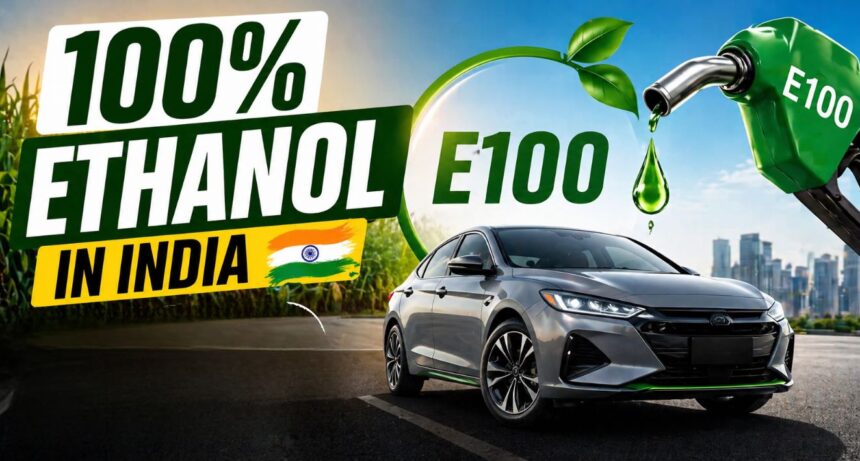
India is gradually moving towards cleaner fuels, and one of the latest ideas being discussed is 100% ethanol fuel, also called as E100. Till now, most petrol in India already contains some ethanol mixed in (like E10 or E20). But with E100, the idea is very different, the fuel will be completely ethanol with no petrol at all. In simple terms, your car would run on fuel made from crops like sugarcane or maize instead of Petrol or Diesel.
What Exactly Changes with E100?
While the idea sounds simple however it’s not as easy as just filling ethanol in your current car. Ethanol behaves differently from petrol, so regular petrol cars cannot run on it safely. Vehicles need to be specially designed as flex-fuel cars, where the engine, fuel lines, and sensors are adapted to handle ethanol. These cars known as Flex Fuel Cars can adjust automatically depending on the fuel mix and ensure smooth performance without damaging components.
Advantages for Car Buyers
One of the biggest benefits of ethanol is the possibility of lower and more stable fuel costs. Since ethanol is produced locally, India can reduce its dependence on imported crude oil, which often fluctuates in price.
Another important advantage is that ethanol burns cleaner than petrol. This means lower emissions, which can help improve air quality, especially in crowded cities. At the same time, using ethanol supports the agricultural sector because it is made from crops. This creates an additional income options for farmers and strengthens the rural economy.
Disadvantages for Car Buyers
Despite the positives, there are some practical downsides also. The biggest issue is lower mileage. Ethanol contains less energy than petrol, so cars running on E100 will typically deliver 20–30% lower fuel efficiency.
In addition, buyers will initially have fewer vehicle options since only specific flex-fuel models will support this fuel.
Another small but important concern is cold start performance. Ethanol does not ignite as easily as petrol, so starting the car in colder conditions may not be as smooth.
What About Other Countries Using E100?
Globally, Brazil is the only country where 100% ethanol is widely used in everyday vehicles. Most cars there are flex-fuel and can run on petrol, ethanol, or a mix of both. Drivers simply choose whichever fuel is cheaper at the pump. This system works well because Brazil has strong sugarcane production, proper infrastructure, and long-term government support.
In contrast, countries like the United States and those in Europe mainly use blended fuels like E10 or E85, not pure ethanol. This is because E100 comes with challenges like lower efficiency, cold-start issues, and infrastructure requirements. So while ethanol is used globally, E100 at scale is still rare outside Brazil.
Impact on Car Manufacturers
For car manufacturers, ethanol presents both opportunities and challenges. On the positive side, switching to ethanol is easier than going fully electric. Companies can modify existing petrol engines instead of building completely new platforms like EVs. This also means lower development costs compared to electric vehicles.
However, manufacturers still need to redesign parts of the engine and fuel system to handle ethanol safely. This involves additional investment and testing. At the same time, there is uncertainty in the market because it is not clear how quickly customers will adopt E100 vehicles. Companies are also dealing with multiple transitions at once like petrol, ethanol, hybrid, and electric and this makes long-term planning more complex.
Final Thoughts
The move towards 100% ethanol is not about replacing petrol overnight. It is part of a broader strategy to reduce oil imports, support farmers, and move towards cleaner mobility without depending entirely on electric vehicles just yet. For buyers, it means a trade-off — slightly lower fuel costs and cleaner emissions, but reduced mileage and limited availability in the beginning. For manufacturers, it is a practical step forward, but not a complete solution.






👍👍